
The Missing Link: Cisco’s Quantum Switch
Cisco has introduced a "universal quantum switch" that acts as a translator to enable communication between disparate quantum systems, overcoming the challenge of sharing fragile quantum data. The device operates at room temperature on existing fiber-optic infrastructure, paving the way for networked, rather than isolated, quantum computing.
TECHAB'S TECH INSIGHTS WEEKLYLATEST
Anshumaan Bakshi
4/28/20262 min read
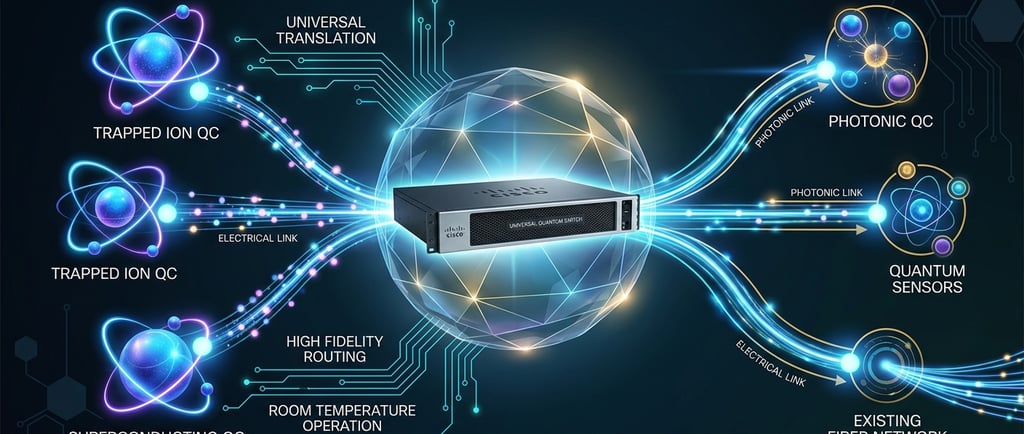
The Missing Link: Cisco’s Quantum Switch and the Future of the Interconnected Quantum Web
For years, the race for quantum supremacy has been a solitary one. Tech giants like Google and IBM have focused on a single, monumental goal: building a more powerful, stable, individual quantum computer. But even the most advanced quantum processor today faces a fundamental limitation—it works in isolation. Quantum computers currently cannot "talk" to one another, a gap that prevents them from scaling into a truly global, collaborative network.
Last week, Cisco introduced a potential solution that could shift the entire industry’s trajectory: the Universal Quantum Switch.
The Challenge: Sending "Soap Bubbles"
Communicating in the quantum world is notoriously difficult. Unlike traditional data, which can be copied and resent, quantum information is incredibly fragile. It exists in states of probability that collapse if disturbed. Experts often compare sending quantum data to carrying a soap bubble across a crowded room—the slightest interference causes it to pop.
Furthermore, different quantum computers use different "languages." Some operate using light (photons), others via electrical circuits or trapped atoms. Bridging these incompatible systems while keeping the data stable has been a roadblock for decades.
How Cisco’s Switch Changes the Game
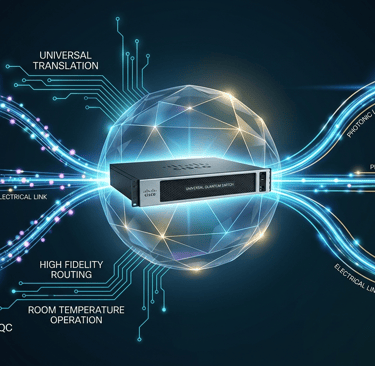
Cisco’s "Universal Quantum Switch" acts as a sophisticated translator and router. It solves three major problems:
Universal Translation: It accepts quantum signals in various encodings (like light direction or timing) and translates them into a common format for routing, ensuring different systems can finally understand one another.
High Fidelity: Normally, measuring quantum data destroys it. Cisco’s tests showed a degradation of 4% or less, meaning the data stays almost perfectly intact during the "translation" process.
Real-World Scalability: Most quantum hardware requires temperatures colder than outer space to function. Cisco’s switch works at room temperature and plugs into existing fiber optic cables. This means we don't need to rebuild the internet; we can layer quantum capabilities on top of our current infrastructure.
Why "Distributed Quantum" Matters
The shift from building one giant machine to connecting many smaller ones is revolutionary. By linking several 1,000-qubit machines, you effectively create a 100,000-qubit system. This "divide and conquer" approach could unlock massive breakthroughs in:
Medicine & Chemistry: Simulating complex molecular interactions for drug discovery.
Unbreakable Security: Using the laws of physics to create networks where any "eavesdropping" is physically impossible.
Astronomy: Synchronising distant telescopes to create a massive, high-resolution virtual lens.
The Road Ahead
While Cisco’s switch is currently a research prototype and a full-scale "Quantum Internet" is likely years or even decades away, the philosophy has changed. The future of quantum computing may not be about who builds the biggest machine, but who builds the best bridge.
Connect
Explore my services and portfolio for growth.
Inspire
Create
+91 78278 45113
© 2026. All rights reserved.
Like this website ?? Own a similar one! Click here to learn more