
The High-Orbit GPU Gamble: Why AI Infrastructure is Breaking Earth’s Atmosphere
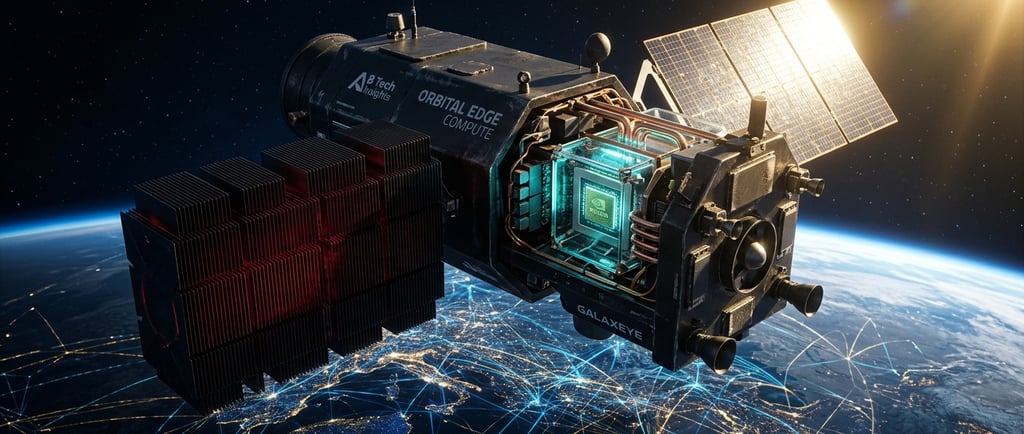
Mission Drishti (GalaxEye) and the Pathfinder satellite (Pixxel) aren't just vanity projects. They represent a fundamental shift in data architecture.
TECHSYNTHESISLATEST
Anshumaan Bakshi
5/11/20262 min read
For decades, we’ve treated the "cloud" as a metaphorical abstraction—a place where data simply exists. But as the generative AI race turns into an all-out arms race, the physical reality of the cloud is hitting a wall. Terrestrial data centers are now "hyperscale" behemoths consuming the electricity of small cities and enough freshwater to sustain entire ecosystems.
Why now? On May 3, 2026, GalaxEye’s Mission Drishti proved we can fuse satellite sensor data in real-time. But the real kicker came earlier this week: Pixxel announced Pathfinder, India’s first orbital data center. We are no longer just sending data to space; we are sending the silicon to process it there.
The Structural Friction: Terrestrial Limits vs. Orbital Ambitions
We are witnessing a collision between Earth’s resource constraints and the insatiable appetite of modern AI models. The friction manifests in three critical areas:
· The Power Bottleneck: Terrestrial solar is intermittent; orbital solar is near-continuous. Compute is essentially "bottled energy," and space offers a deeper well.
· The Resource Conflict: In densely populated regions like India, we’re facing a zero-sum game: Do we use land and water for manufacturing and people, or for server farms ??.
· The Latency Loop: Currently, we beam raw imagery to Earth, process it, and send insights back. Moving the GPU to the sensor eliminates this loop, enabling instantaneous intelligence for defense and disaster response.
The Reality Check: Physics, Bit Flips, and the $142 Hour
Before we pivot entirely to the stars, we have to talk about the "ground truth" of space—which is incredibly harsh.
1. The Thermal Trap: Vacuum is a great insulator, but a terrible conductor. Without air for convection, GPUs must rely on slower radiation systems to bleed off the intense heat they generate. If you can’t cool the chip, it’s just expensive space junk .
2. Radiation & "Bit Flips": Cosmic rays don't just degrade hardware; they cause computational errors by flipping bits in memory. While recent NASA tests show modern GPUs are heartier than we thought, long-term reliability remains a giant question mark .
3. The Economic Chasm: This is the real friction. Running an H100-equivalent GPU on Earth costs ~$1/hour. In orbit? $142/hour. That 142x premium is almost entirely due to launch costs .
TL;DR: The Orbital Compute Snapshot
· The Move: Startups like Pixxel and GalaxEye are moving GPUs into orbit to process data at the source (p. 1).
· The Why: Earth is running out of cheap land, water, and power for hyperscale AI (p. 3).
· The How: AI models (like Sarvam’s) will run directly on "Pathfinder" satellites (p. 2).
· The Catch: Thermal management is hard, radiation causes errors, and it's 140x more expensive than land-based compute (pp. 3-4).
· The Outlook: It’s a specialized niche for now—critical for sovereign intelligence, but too pricey for your average LLM (p. 5).
The Verdict: A Strategic Specialization
Orbital data centers won't replace AWS or Azure tomorrow. However, they represent the "Specialized Extension" era of infrastructure. For mission-critical workloads—military intelligence, precision agriculture, and climate monitoring—the speed of "insight-only" transmission outweighs the cost (p. 5).
The long-term viability depends on reusable rockets collapsing launch costs. If the $142/hour drops to $10, the "Space Cloud" becomes the ultimate strategic edge. For India, being first in this niche isn't just about tech—it's about infrastructure sovereignty.
Thank you for reading AB Tech Insights Weekly.
Have thoughts on the orbital edge? Drop us a line: reach@anshumaanbakshi.com
Connect
Explore my services and portfolio for growth.
Inspire
Create
+91 78278 45113
© 2026. All rights reserved.
Like this website ?? Own a similar one! Click here to learn more