
Gordon Tullock’s Legacy: Why the "Rent" in Paper Leaks Has Nothing to Do with Your Apartment
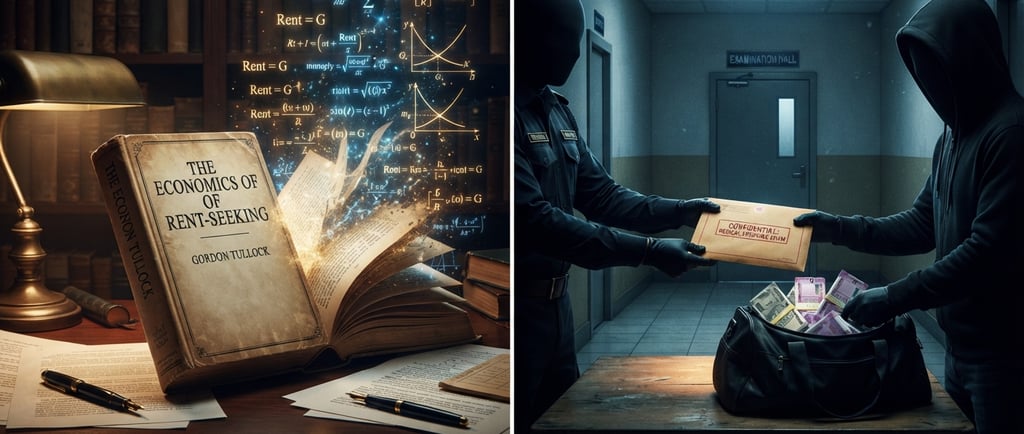
When a wealthy, unqualified buyer hands over 50 lakh rupees for a leaked exam sheet, they are buying a literal "textbook economic rent." They are purchasing a guaranteed, lifelong revenue stream—a doctor's license—without paying the intellectual cost required to earn it.
LATESTON THE RADAR
Anshumaan Bakshi
7/28/20263 min read

Gordon Tullock’s Legacy: Why the "Rent" in Paper Leaks Has Nothing to Do with Your Apartment
TL;DR Version
Not Apartment Rent: "Economic rent" refers to capturing a massive, unearned financial premium over actual costs.
The Tullock Formula: Coined by Gordon Tullock, the concept exposes how people spend fortunes to rig monopolies rather than create value.
Perfect Textbook Case: The paper cartel creates an artificial bottleneck, turning a public exam into a private auction.
Deadweight Loss: Millions of rupees are sucked out of the productive economy and channeled into black-market bribes.
The Human Cost: The unearned "rent" secured by cheating students directly results in an incompetent healthcare workforce.
To truly understand why the paper-leak crisis is a "textbook" case of this phenomenon, we have to look at the man who first mapped out this economic rot: Gordon Tullock. Along with Anne Krueger, Tullock realized that conventional economics was missing a massive category of systemic waste.
When most people hear the word "rent," they think of writing a monthly check to a landlord for an apartment. In macroeconomics, "economic rent" means something entirely different. It is any surplus payment a person or business captures that goes wildly beyond what is required to actually provide or produce that resource. It is pure unearned premium. Rent-seeking is the aggressive, often expensive pursuit of that unearned jackpot—and the paper-leak industry is its purest, most devastating modern mutation.
The Structural Friction: How the Paper Cartel Exemplifies Tullock’s Model
Gordon Tullock’s core breakthrough was proving that people will spend massive amounts of resources just to secure a state-enforced or artificial monopoly. The paper-leak cartel doesn't just stumble into money; they systematically build a Tullock-style trap:
Manipulating the Entry Gate: In a healthy market, a medical seat belongs to the person who put in the cognitive labor. The cartel uses stolen papers to artificially hijack that gate, shifting the reward from merit to raw capital.
Wasted Social Resources: Tullock noted that the worst part of rent-seeking is the deadweight loss. Millions of rupees that could fund rural healthcare, upgrade medical colleges, or build better infrastructure are instead burned on bribing insiders, secure couriers, and underground syndicates.
The "Zero-Sum" Collapse: Unlike true capitalism—where a new invention expands the economy—this is a zero-sum game. No new medical seats are created. No better doctors are trained. The cartel simply steals a fixed public asset and auctions it to the highest bidder.
The Technical and Economic Reality: The Destruction of Public Utility
When a wealthy, unqualified buyer hands over 50 lakh rupees for a leaked exam sheet, they are buying a literal "textbook economic rent." They are purchasing a guaranteed, lifelong revenue stream—a doctor's license—without paying the intellectual cost required to earn it.
Tullock argued that this behavior actively degrades society because it replaces productive effort with political or structural maneuvering. When this happens to medical exams, the "rent" collected by the cartel turns into a lethal tax on the public. A student who buys the answers bypasses the brutal filtering process designed to ensure a doctor can handle high-stress clinical decisions.
By allowing capital to substitute for competence, the market produces graduates who hold the title of "Doctor" but possess zero actual utility. The ultimate economic reality is a severe, systemic deficit of actual medical talent, leaving future patients to pay the price for a cartel's unearned surplus.
The Verdict
Gordon Tullock warned us decades ago that when the state or an institution creates a high-stakes bottleneck, syndicates will form to exploit it. The paper-leak business is not a random criminal anomaly; it is a highly calculated, economically rational response to an absolute monopoly on medical licensing. If we continue to treat paper leaks merely as security slip-ups rather than a deeply entrenched, multi-million dollar rent-seeking ecosystem, we will continue to watch our public healthcare infrastructure collapse from the inside out.
Thank you for reading this week's analysis. For editorial feedback, technical corrections, or submissions, please contact us at: reach@anshumaanbakshi.com.
Connect
Explore my services and portfolio for growth.
Inspire
Create
+91 78278 45113
© 2026. All rights reserved.
Like this website ?? Own a similar one! Click here to learn more